/ /

What are Hook Rate and Hold Rate? How do I view them in Meta/Google Ads?

Jul 02,2026 | Mango media

If you've been doing ad campaigns for a long time (especially video ads), you've probably heard this complaint: "This ad has a low ROAS, and the creative is no good."
But what exactly is wrong? Is it not attractive enough, or is it unable to retain customers?
Today we're going to talk about two metrics that are crucial for optimizing content: Hook Rate and Hold Rate .

What exactly are these two indicators looking at?

Optimizing content essentially boils down to two things: whether it can make people stop watching and whether it can make people finish watching.

1. Hook Rate:

Formula: Number of plays in 3 seconds ÷ Number of impressions
How many people are stopped by you within the first 3 seconds of the ad scrolling by?
A low hook rate has only one reason: the first 3 seconds aren't engaging enough. It has absolutely nothing to do with how well you explain your selling points later, because people simply don't have a chance to see them.

2. Hold Rate :

Formula: 10/15 seconds / full playback ÷ number of 3-second playbacks
How many people are willing to continue reading?
Underlying logic: This is about the retention rate of your content. It reflects how engaging and relatable your content is over time.
A low hold rate means you've lured people in, but the content is too weak or the pacing is too slow, so they leave after a couple of glances.
Key points:
Hook Rate determines whether your money is being wasted (ineffective exposure).
Hold Rate determines whether your traffic is targeted (effectively persuading).

How can I bring them up in the background?

Meta doesn't display these two metrics by default; you need to create them manually. Don't be lazy, spend 3 minutes setting them up, and your team's communication efficiency can double.
Set path:
Ads Manager → Columns → Customize Columns → Create Custom Metric

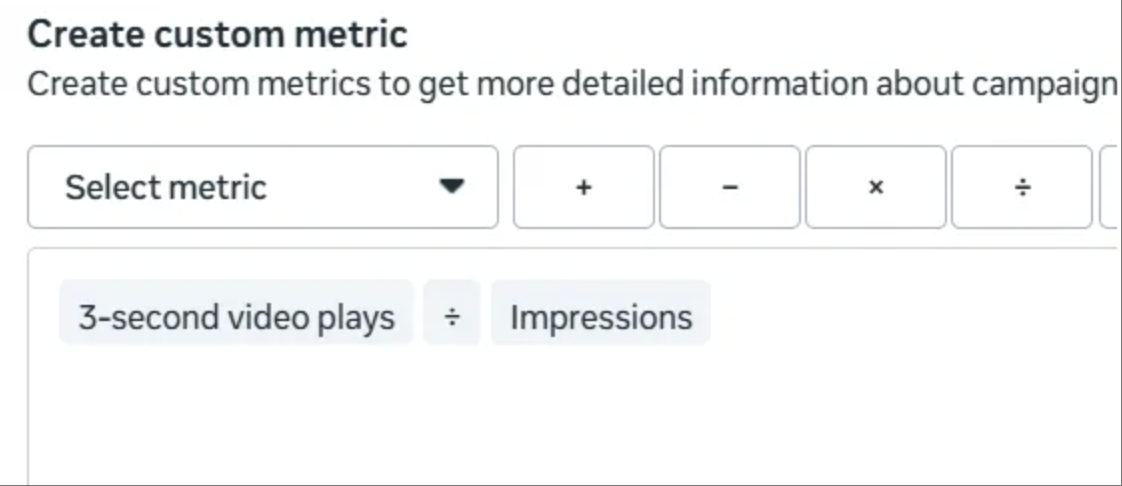
1. Set Hook Rate

Formula input: 3-second video plays ÷ Impressions
Format: Select percentage (%)
Suggested naming: Hook Rate (3s/Imp) — Add a suffix so that new colleagues can understand it.

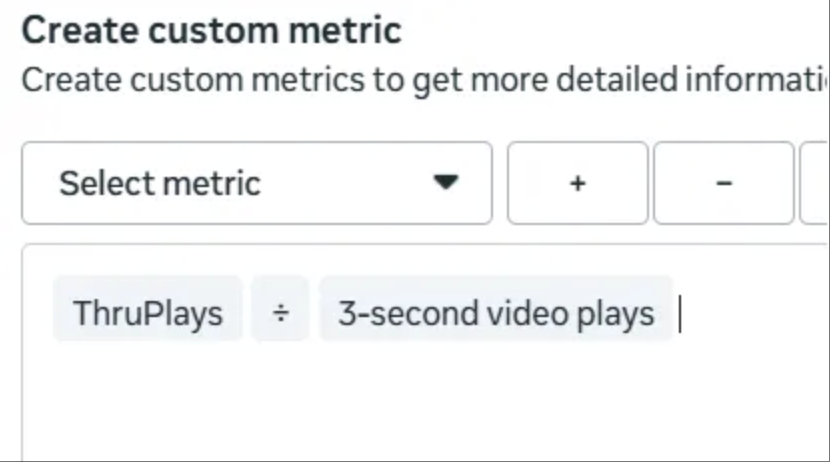
2. Set Hold Rate

Formula input: ThruPlays ÷ 3-second video plays
Format: Select percentage (%)
Suggested naming: Hold Rate (Thru/3s)

What score is considered passing?

Although data may vary depending on the industry, country, and audience, here is a practical reference line (for reference only):
Hook Rate ≥ 25%: Passing grade. Below this, your first 3 seconds will basically discourage users.
Hook Rate ≥ 30%: Excellent.
Hook Rate ≥ 35%: Potential for a blockbuster hit – this is the "Hook King" we're looking for.
Here's a reference for determining the order: look at the Hook first, then the Hold.
For example:
Suppose we have the same video, and we're running two different audience targeting schemes:
Group A (website visitors): Hook Rate 32%
Group B (Interest): Hook Rate 16%
However, their hold rates are roughly the same.
Therefore, we can infer that the video content itself is fine; the problem lies in the first 3 seconds, which do not match the tastes of Group B.
Don't turn off the footage; give Group B a new start and keep running.

Test Structure

1 Ad Set
Include 3 videos (with different beginnings or different structures).
Budget: 15/day
Duration: 7 days (approximately 105 minutes)
One week later:

Find the one with the highest Hook rate

Analyzing its first 3 seconds: Did it use visual contrast? Or did it raise a pain point question?
Extract this beginning and use it as a hook template.

Find the highest hold rate

This indicates that its narrative rhythm in the middle is correct and its logic is sound.
Preserve its middle and rear skeletal structure.

stitching iteration

The next round of new material =  the first 3 seconds with the highest hook rate +  the middle and later parts with the highest hold rate .

3 ways to increase hook rate

If you're unsure how to modify the first 3 seconds or what to do, try these examples:
Reversal:
To grab attention from the start: "This deal is a lie!" (to pique curiosity)
Then a twist: the offer wasn't fake.
Let's get straight to the point:
Initially: I had been using the pillow for a month
She then said that this was the softest pillow she had ever used.
Compared to "competitors":
Initially: I was fed up with Amazon's poor-quality products.
Then he said they finally found the correct product.

How to view Google Ads in the ad backend


Google Ads does not have native Hook Rate and Hold Rate fields in its backend.

But this doesn't mean we can't see similar data; it just means we need to combine them in a different way.

Google's backend provides four video-related metrics: Video Played to 25%, Video Played to 50%, Video Played to 75%, and Video Played to 100%.

This data tells you how many viewers are still present at different points in the video—what percentage of people have seen 25%/50%/75%/100% of your footage.

For example, with Dolce & Gabbana ads, if your creative is shorter than 10 seconds, the system will indicate that the ad placement is limited.


Therefore, to ensure sufficient exposure, I would recommend using videos longer than 10 seconds, and 25% of 10 seconds is roughly 3 seconds.
According to Mr. Tupa's experience, the higher the playback percentage reaches 25%, the more stable the ROAS will be.
A 100% completion rate is not very important.

summary

There are both mystical and scientific aspects to advertising.
The value of Hook Rate and Hold Rate lies in transforming vague creative ideas into quantifiable, reviewable, and replicable data assets.
You can remember this decision-making logic (for reference):
High Hook + High Hold → Increase budget and expand audience
Hook high + Hold low → Keep the beginning, heavily edit the middle section
Hook low → Don't bother looking at it, just redo the beginning.
When you start using this logic to examine your footage, you've already left 80% of the video editors who are still editing based on gut feeling behind.

Want to boost your Meta Ads performance?

Mango Media provides specialized advertising solutions designed to help businesses scale confidently across Meta, Google, and TikTok.

  • Meta Campaign Stability
  • Meta Advertising Solutions
  • Meta Agency Account
  • Facebook Advertising Account
  • Meta Ads Best Practices
  • Nutra Advertising
  • Dating Advertising
  • Imaging Advertising
  • Advertising Infrastructure
  • Meta Account Management

Comment

Name
Email
Comment